
Shettima, Akabueze, Others Call For Realistic, Sustainable Budgeting Process

…Budget Process Not Governed By Clear Laws, Rules-Akabueze
By Chidinma Obiakor
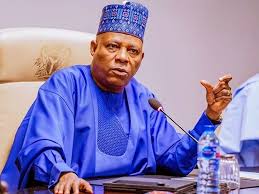
The Vice President, Senator Kashim Shettima, former Director General, Budget Office, Ben Akabueze and others have advocated for revitalisation and reforms to ensure a more realistic and sustainable budgeting process in the country that is tied to the country’s quest for development.
They made the call in separate remarks at a Two-Day National Policy Dialogue which began in Abuja on Tuesday organised by the National Assembly Joint Committee on National Planning and Economic Development with the Theme: “The Imperatives of National Development Plan for Effective Budgeting System and Sustainable Growth Of the Nigerian Economy”.
In his remark, the Vice President who was represented by the Special Adviser to the President on Economic Matters, Tope Fasua said the two-day discourse was formed around how as a country Nigeria can quicken its pace of development by integrating national development plans more with the yearly budgets and project into the medium and long term for the country.
He said, “At the very time, it was a very important topic for the moment and for the time to come in view of President Tinubu’s great vision for the people of Nigeria, according to the renewed agenda of Mr. President.
“Also, it’s asked, how can our budgets be impacted more positively by these plans and how do we institute a path towards sustainable growth, which not only focuses on the annual trajectory of our domestic product GDP, but also focuses on the improvement of standards of living of our people as measured by reduction in poverty rates and the rise of per capita income.
“This is an apt moment to echo the thoughts of President Bola Ahmed Tinubu, and the Minister, the Minister of Budget and Planning, to the extent that our budgets should not only be people-focused. But our budgets should actually be larger than they are presently. This informed the recent adjustment to the 2026 budget, fiscal budget, by about 10 trillion line, to taking the sum to 68 trillion”.
Senator Shettima noted that, some critics, have opined that Nigeria should have a much smaller budget. He however said that, they need to be reminded that budgeting is not a process of reviewing past shortcomings and capitulating to limitations, but a process by which Nigeria documents its greater future and challenges itself to do even better than the past.
The Vice President added, “The usual refrain about revenue generation has been well addressed by Mr. President’s Acts on Revenue Reforms, which have kicked in since January 2026, with great promise. Many institutions have become fiscalized. Many are leading to a decline.
Many institutions have become fiscalized. Many are leading to a better capture of revenues that would have otherwise been lost to government.
“Technology has also been deployed to get to where human beings need to go. And so we believe that revenue numbers for 2026 and beyond will paint a positively different picture. Indeed, we must also recognize the recent Fiscal Policy Measures, (FPMs), which were articulated by the Office of the Minister of Finance and Foundation Management. Nor is it a symbol of the beneficial and positive impact of high-quality business on the economy”.
He further explained that, many tariffs on essential raw materials and other similar products were reduced to the benefit and further benefit of the citizenry tariffs on essentials, raw materials and other similar products were reduced adding that Duty of pharmaceuticals, fabric, machinery, and some specific manufacturing equipment have also been removed with a view to encouraging higher productivity in critical sectors.
He added, “This deft move signals that the Tinubu government greatly cares for the people of Nigeria, and there is so much more to come. Economic planning is a national imperative, and President Tinubu is a great believer in this idea, not necessarily in the rigidities and strictures reminiscent of Soviet-era economics, but in a more nuanced and data-driven manner, which quickly distills into the economic well-being of the people.
“Currently, our budgets are being guided by the Medium-Term Expenditure Framework (MTEF) as well as the national development plans. These plans could be put together by the budgets and planning ministry. Distinguished ladies and gentlemen, the largest room in the world is the room for improvement. Therefore, in spite of current achievements and structures of ground, a lot more can be achieved, especially around sustainable development.
“Again, this will be measured by higher per capita income for our people and long-term growth. As well as better standards of living and significant leaps in the 17 metrics measured under the United Nations Sustainable Development Goals. Measurements around poverty in general, food poverty in particular, health, education, water, and much more”.
On his part, the Former Director-General Budget Office, Ben Akabueze who presented a paper titled, “Linking Budgeting To Planning and Bridging The Implementation Gap In Nigeria: Strategies For Enhanced Fiscal Discipline, Development Outcomes, And Accountability” stated that, Nigeria had over the years had several development plans.
He said, Currently we have the Renewable Medium-Term Plan 2026 to 2030.It’s important to make a point upfront that even the budget itself is a plan. But it is intended to be a snapshot of that development plan for the one-year period. However, persistent gaps between development plans and actual implementation have adversely affected development outcomes.
“And one symptom of that which makes the case incontestable is the fact that we currently have estimated over 56,000 abandoned projects scattered around the country. This is without any doubt at all a symptom of failure in linking our budgets to our plans and therefore development outcomes. A budget should be the compass that directs resources toward development priorities.
“But truth be told, it’s helpful to what extent our budgets have achieved this objective. To serve as a compass to direct our resources toward development priorities. I believe that the goal of all of us today must be to move from budgeting for expenditure to budgeting for development outcomes.
“And it’s from that perspective that I make this presentation. Why do we have the gaps? Let’s try and define this problem. One of the reasons we have this gap, I believe, is the absence of a budget law.
“Our budget process, and I’m speaking about fair government, is not governed by clear laws and rules. The constitution, which is the ground law, makes some vague provisions about the budget. To illustrate how vague those provisions are, the constitution just says the president will lay a budget to the National Assembly before the beginning of the fiscal year to which the budget applies.
“So technically, based on Nigeria’s constitution, if the president laid the budget for 2027, the National Assembly, on the 31st of December 2026, he would be in compliance with the constitution. The constitution is very vague in terms of defining the respective roles of the executive and the legislature in the budget process. And that’s why, since 1999 consistently, we’ve had these conflicts.
“So, what is normal in whatever constitutional provisions is for countries to enact budget laws, often referred to as organic budget law. There have been several attempts to do so. The last attempt that I was part of, actually the 9th House of Reps had it as one of their cardinal goods to pass the budget law.
“If you look at their agenda, the legislative agenda of the 9th House of Reps. And they finally got it passed in the twilight of President Buhari’s administration. And the Senate passed it also, but the president didn’t get to sign it before he left.
“And up till now, the law hasn’t been signed. It wasn’t the ideal law that we saw, but we thought it was progress. So, this is something, a budget law will clearly define the processes, establish timetables, responsibilities, who does what, by when, because the budget is that serious.
“We also then have the challenge of weak linkage. There’s a disconnect between our national plans and our budget allocations. That’s not how it is designed to be, but that’s the reality of what we have in practise”.
He however suggested recommendations that will make the process better for the development of the country.
Independent journalism, sustained by readers like you.
The Parliament Diary is published by The Parliament Cable Network Service Limited. Your support helps us keep covering governance, parliamentary affairs and grassroots politics across Nigeria.