
Great Rulers of the Niger Delta:The Parliament Diary Interview Series…Give Us Our Right – HRM

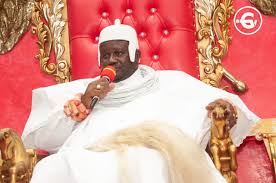
HRM Ebenanaowei
In this riveting interview, His Royal Majesty, Elder (Capt.) Joseph I. Timiyan (JP) PhD, the revered King of Ogulagha Kingdom, opens up candidly about the profound challenges confronting traditional rulers across Nigeria’s Niger delta region. Speaking from his ancestral palace in Burutu Local Government Area, the king delivers unfiltered insights into an institution laboring under existential hardship—chiefly its glaring lack of constitutional recognition, eroded authority amid oil politics, land disputes, and security threats, leaving custodians of ancient heritage pleading for legal empowerment and governmental partnership. He was interviewed by The Parliament Diary team: Ma’ashin Ibn Ma’ashin, Precious Enebuse and Priscilla Martin
Excerpts:
Q: Your Majesty, may we begin with your full name for the record, sir?
HRM Ebenanaowei: I am His Royal Majesty, Elder (Captain) Joseph I. Timiyan, JP, PhD—known traditionally as Agbonu Torubobor I and Torububou 1, the Ebenanaowei of Ogulagha Kingdom in Obotobo 1, Burutu Local Government Area, Delta State. By God’s grace and ancestral mandate, I ascended the throne in 2005 as the 18th Ebenanaowei, serving as spiritual head, territorial custodian, and chairman of the Delta State Ijaw Traditional Rulers Forum.
Q: Thank you, Your Majesty. That’s most gracious.
HRM Ebenanaowei: You are Welcome.
Q: Your Majesty, what are the major challenges facing traditional institutions today?
HRM Ebenanaowei: The challenges are numerous, but the most critical remains the federal government’s failure to constitutionally recognize traditional rulers. This omission leaves us without defined roles and rights at the national level. We serve as chief security officers of our kingdoms—peace at the kingdom level ensures state stability, which in turn secures the federation. Without constitutional backing for our functions, our authority remains ambiguous.
While state governments formally recognize us through staffs of office and local governments acknowledge our existence, the federal constitution ignores us entirely. Consequently, we lack voice in national affairs despite our strategic importance—particularly for oil-producing kingdoms like mine. Iborayha Kingdom may sound unfamiliar, but it hosts Nigeria’s highest crude oil loading point at Iborayha, alongside Abazape loading point (owned by Botinayo of Idu), multiple SORA flow stations, Oando terminal (formerly under NNPC, now Niger Delta Exploration), and operations by numerous multinational oil companies.
No kingdom in Nigeria rivals ours in production—not even Bonny. Among major terminals (Escravos, Warri, Brass), Iborayha stands as the world’s highest-producing kingdom. Yet federal recognition eludes us:
- No national convocations: When traditional rulers are summoned to Abuja, Iborayha’s Ebenanaowei is forgotten
- Crisis-only visibility: Pipeline disturbances bring sudden attention; smooth production means total obscurity
- Zero infrastructure: No federal roads, no university (despite our size), no development projects
- No appointments: Not one son or daughter serves as board chairman, member, or federal appointee
- Maritime neglect: Like Bonny, we battle severe coastal erosion with no federal protection
Iborayha’s geopolitical significance cannot be overstated. Our sea-exposed terrain forms Nigeria’s maritime frontier—beyond our boundaries lie Ghana, Benin Republic, and Cameroon. We are the nation’s first line of defense, yet invisible to federal policymakers.
The East-West Road rehabilitation represents the only visible federal presence in the Niger Delta, but Iborayha receives nothing. Constitutional recognition would compel the respect our oil production commands and secure our legitimate rights as traditional sovereigns with defined national roles.
State governments know our existence, but awareness doesn’t translate to adequate action. These represent our primary challenges—though many others exist which time doesn’t permit me to fully enumerate.
Q: Your Majesty, aside from the infrastructure deficits you mentioned, what privileges or royalties does your kingdom receive?
HRM Ebenanaowei: Nothing. How can someone who doesn’t even acknowledge your existence pay you royalties? The federal government knows absolutely nothing about me or my kingdom.
This exclusion affects the entire South-South and Niger Delta region, but riverine communities like ours face the worst marginalization. They treat our terrain as if it is not part of Nigeria—while treating our crude oil resources as if they belong to the entire federation.
The indigenes of riverine areas receive zero recognition as legitimate stakeholders. We are never invited to national policy discussions, never considered as development partners, never treated as equal citizens. No royalties, no stakeholder status, no federal engagement—there is truly nothing to discuss regarding privileges or financial benefits for our kingdom.
Q: Your Majesty, is the stipend paid to traditional institutions by the state government sufficient to sustain your role?
HRM Ebenanaowei: Absolutely not—allow me to explain. I hail from Burutu Local Government Area, which rivals some entire states in size and significance. Burutu boasts a full slate of House of Assembly members and its own House of Representatives seat. It hosts 14-15 kingdoms, all sharing a 5% allocation from local government funds channeled to traditional rulers.
I suspect this 5% derives from net profit rather than gross allocation, rendering it woefully inadequate. After division among 14-15 rulers, the share cannot even fuel my boat for essential duties. A single round trip from Warri to Iborayha recently cost over ₦1.7 million in fuel alone—excluding engine maintenance and other expenses.
Riverine operations are exponentially costlier than urban governance. While government deems our terrain “difficult to develop” (a valid assessment), they extract crude oil effortlessly from the same challenging environment. Iborayha Kingdom encompasses over 15 communities, some developed to near-city status, with others far behind.
Governance amid poverty is profoundly challenging—subjects are harder to lead when basic needs go unmet. A prosperous populace yields willing obedience; deprivation breeds resistance. Yet divine grace sustains peace: God elevates one to kingship over potentially defiant subjects, then provides the blessings needed to maintain harmony.
The 5% allocation serves nowhere adequately. Some Delta State local governments host only one king and manage comfortably; others span two local governments, concentrating benefits. Burutu’s multiplicity renders it impossible. We survive through resilience, maintaining dignity without public lamentation—projecting strength so others continue to respect us.
Q: Your Majesty, what efforts have traditional institutions made to reach out to the federal government?
HRM Ebenanaowei: We maintain structured advocacy through local government councils of traditional rulers and the state council of traditional rulers, where both local and state levels are represented. However, federal engagement remains elusive.
How do we advance our cause? It requires political champions—representatives willing to champion traditional rulers’ interests at the national level. The state government makes efforts, but federal buy-in proves challenging. Politicians often view our constitutional involvement as a threat to their authority rather than a partnership for national stability. Without committed intermediaries, our structured councils achieve limited federal penetration
Q: Your Majesty, you mentioned a public presentation at the National Assembly?
HRM Ebenanaowei: Yes, certainly. We’ve made presentations, but implementation remains the challenge. We need genuine champions in the National Assembly—legislators committed to embedding traditional rulers’ roles within the constitution.
The real hurdle lies with approval. Some view our constitutional involvement as a power grab—believing it would diminish their authority. This resistance persists despite our critical role in maintaining grassroots stability. Nevertheless, we continue praying that one day, this recognition will materialize.
Q: Your Majesty, that brings us to another disturbing question. With Nigeria’s ongoing insecurity crisis, what solutions do you propose?
HRM Ebenanaowei: I’ve spoken little about insecurity because my kingdom remains peaceful—not from personal perfection, but divine protection. Iborayha’s sparse population shields us; the violence seen in the North (100 killed today, 50 tomorrow) would decimate our communities entirely. God preserves us.
We are Edo-Ijaw people who love peace, practice honesty, and embrace contentment. Insecurity stems from greed—those who aim beyond God’s provision invite chaos. Whatever we possess, we cherish it gratefully. My throne is dedicated to God; divine allegiance repels such threats.
Nigeria grapples with profound insecurity, and I sympathize deeply. I pray they experience the peace we enjoy in Iborayha—a tranquility born from satisfaction, faith, and cultural values that reject excess ambition.
Q: Your Majesty, what is your appeal to the National Assembly and Federal Government regarding these challenges?
HRM Ebenanaowei: My appeal is clear: embed traditional institutions in the constitution to grant us defined constitutional rights, just as elected officials enjoy.
Governors have local government chairmen serve 3-year terms, governors and presidents have 4-year mandates, senators and House members have legislative backing—all constitutionally protected. Traditional rulers have no such framework.
Involve us formally. Peace in every kingdom guarantees peace across Nigeria—this is the fundamental truth. Constitutional recognition of our roles as chief security officers and community stabilizers would secure the nation from the grassroots upward.
Q: That’s an excellent point to wrap up. Thank you for the privilege, Your Majesty.HRM Ebenanaowei: Thank you
Independent journalism, sustained by readers like you.
The Parliament Diary is published by The Parliament Cable Network Service Limited. Your support helps us keep covering governance, parliamentary affairs and grassroots politics across Nigeria.