

Honourable Uchenna Harris Okonkwo, Representative of Idemili North and South Federal Constituency and Chairman of the House Committee on NAFDAC, was interviewed by Chief Precious Enebuse

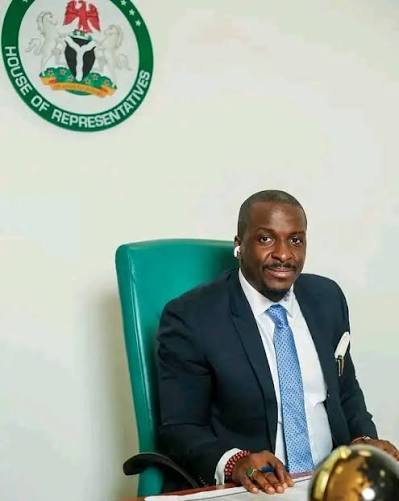
Chief Precious Enebus eCEO of The Parliament Cable Network, publishers of The Parliament Diary. The Representative addressed numerous issues of national importance. Below are excerpts from the interview:
Question: For the benefit of our readers who may not be familiar with you, could you kindly introduce yourself by sharing your personal background, including your upbringing, core values, and academic qualifications that have shaped your career.
Answer: Thank you. My name is Honourable Uchenna Harris Okonkwo. I represent the people of the Idemili North and South Federal Constituency, and I serve as the Chairman of the House Committee on Food and Drug Administration and Control at the National Agency for Food and Drug Administration and Control (NAFDAC) in the House of Representatives.
Regarding my background, I attended my early education in Nigeria and pursued higher education in the United Kingdom and Canada, where I studied at the prestigious University of Toronto. I hold degrees in Political Science, Philosophy, Professional Writing, and Communication, as well as a diploma in Advanced Finance and Mechanics. My upbringing was very simple.
I am the son of the late Senator Anyo Okonkwo, who served in the Senate from 2007 to 2011 during the Seventh Assembly. He served with grace, and I pray he rests in perfect peace. My core values are integrity and leadership with vision and wisdom. Wisdom comes from God, and I believe that everything is from God. I will continue to pray to Him.
I also believe that when you set out to attain something and put in the effort to achieve it, success will follow in brilliant colours. Those are the main points regarding this question.
Question: Why did you venture into politics, and how has it been representing your constituency so far?
Answer: My initial venture into politics did not simply stem from contesting for a political position. Within my household, we have always engaged in politics, especially as I am the firstborn—not only of my nuclear family but the firstborn of the firstborn in my entire family.
This heritage shaped my dream of leading my people. A leader must lead by example, do things for the people, and support them in any way possible. We do not have unlimited resources, but whatever we have can go a long way for our people.
I cherish this role deeply because I want my people not to be left out in Nigeria’s national conversation. It has been a great journey so far, and I thank God for the opportunity.
When I first contested in 2019, it opened my eyes to electioneering. In 2023, we returned and successfully achieved victory by God’s grace. It has been a wonderful experience, and I always encourage people that politics should be a safe space to venture into. The more people we have who share an accurate voice defined by values and integrity, the better we can make Nigeria, our beloved country, and help our constituents with whatever assistance they need.
Question: In your current capacity as a member representing Idemili North and South Federal Constituency and Chairman of the House Committee on NAFDAC, what strategy goals have you set for your term? Could you elaborate on key legislative or constituency achievements that demonstrate progress?
Answer: Yes, so far regarding our constituency and legislative achievements, the legislature encompasses many facets, and we must participate in all. I have singly sponsored about 14 bills ranging from healthcare bills to a surrogacy bill, the establishment of Federal Colleges of Vocational Studies, Federal Colleges of Skill Acquisition, and a Federal College for Police Training.
We have also introduced the Nigerian Mining Development Bank Bill, which is expected to establish a Nigerian Mining Bank with a structure similar to the Bank of Industry or the Bank of Agriculture, to support our nascent mining sector.
Additionally, we have embarked on necessary empowerment initiatives within our constituency. We have ensured that constituents do feel our impact is present and tangible. These are some of the things we have accomplished.
We have done quite a bit, and most of this information can be found on our media pages via Facebook, Instagram, Twitter, and our WhatsApp platforms that circulate across the constituency.
Question: Politics often involves collaboration across party lines. How has your working relationship been with the Executive Governor of Anambra State and the leadership of the National Assembly, especially considering differences in political affiliation and ideology? What mechanisms have you employed to foster cooperation towards common objectives?
Answer: The Governor of Anambra State, Professor Chukwuma Soludo, CFR, has consistently displayed magnanimity when relating with House members. Even though I belong to the Labour Party, it does not limit my cooperation with the Governor.
Upon my first arrival, I immediately wrote to the Governor seeking a breakdown of areas concerning agriculture where we could make an impact and attract investment through relationships developed with various countries and their embassies, including Portugal, China, and Morocco, where I served on parliamentary friendship committees. We received feedback from the Governor, who enlightened us on areas where the state could benefit, and we got right to work. We cannot play politics in a closed environment.
We strive to be bipartisan in our approach, accommodating every side. In our constituency, we have people belonging to the Labour Party, PDP, APGA, APC, ADC, Boot Party, NRM, SDP, and many others. We cannot ignore these people because they are our constituents, and we recognize the efforts the Governor has made to galvanize everyone.
We will continue to give him our best and work to ensure that Idemili North and South feels the impact of governance. We have also tried to ensure the Governor recognizes that, as a representative of Idemili North and South, we can foster development from within the state’s executive powers and deliver it to the people. For example, healthcare programs that improve primary health care centres, health insurance programs, and maternity programs—these are benefits people can receive from the state, especially now that the state is well-funded. We must take advantage of this relationship and pray that it remains harmonious.
Question: Youth empowerment is critical for national development. From your perspective as a federal lawmaker, are effective government policies and programs being created to provide opportunities for young people to develop their talents and contribute economically? What gaps still exist, and how can they be addressed?
Answer: Youth empowerment encompasses many forms. I believe empowerment should not merely be about giving money. It should be about grooming those being empowered. For example, if you teach a youth how to create ornaments that can be sold, once they complete the course, they should be guided on how to ensure that knowledge does not go to waste.
Empowerment is not a one-time event; it happens frequently. When you identify a group needing empowerment, you develop a program, call them up, set a timeline, and provide training. Examples include training on biogas, ICT coding and programming, community preservation through waste reduction and clean energy, and solar light development and installation.
Once you train someone and provide the necessary tools, you give them not just a skill set but an opportunity to earn for themselves and provide for their families. This is the main goal.
However, I also implore those trained to have an open mind towards utilization. They should not simply sit back and look for quick methods to success. There is no quick story to success. We continue to provide all support we can, and youth empowerment will always be key in any legislative or representative capacity.
Question: Every political career comes with challenges. Could you share what has been the most daunting obstacle you have faced in your journey so far, how you overcame it, and what lessons you have drawn from that experience?
Answer: The most challenging aspect has been staying true to ourselves. In this environment, you can easily get distracted if you are not focused, disciplined, or grounded in your beliefs.
We have managed this very well by not forgetting where we came from, not forgetting our roots, maintaining decorum in our conduct, and building networks of contacts. This is very important because tomorrow is what today prepares for. We always look forward to a better tomorrow.
We can firmly state that anyone who stays true to themselves and their beliefs, without significant change from before coming here, will attain the success they seek.
Question: Looking ahead to the next legislative year, what specific initiatives or projects do your constituents expect from you? How do you plan to address their needs and ensure their interests are effectively represented in the National Assembly?
Answer: In the next legislative year, we will renovate several schools, build classroom blocks, and commence connecting road projects. We will continue empowerment programs, including training on creative arts as a niche area for beneficiaries.
We also plan to involve people in sporting activities by continuing our sporting league, which I hope will metamorphose into a Constituency Football League. I intend to draft a bill for this to trickle football down to the grassroots and gain recognition from the Nigerian Sports Commission and other sporting agencies worldwide. We will develop infrastructure to support sporting activities.
Additionally, every legislative year includes Christmas distributions for the people—it is part of the terrain. Beyond legislative projects, my foundation, the annual Cocoa Foundation, operates year-round with scholarships (we have given over 500 scholarships across Anambra), medical outreaches, and visits to Internally Displaced Persons (IDPs) camps in Abuja, the North, the West, and the East. We are doing more in other places to stretch our foundation’s mechanisms so people see it as trustworthy and reliable.
My staff also undertakes initiatives for relevant people within nuclear communities. We continue to work to ensure the dividends of democracy are spread across Nigeria’s national conversation.
Question: Can you share more light on the constituency sports tournament you mentioned? What will it achieve, and what are its benefits?
Answer: Let me call it the Constituency Sporting League, as it is not limited to football. This is not just a tournament; it will be a league running throughout the year, similar to the English Premier League (EPL), which has Division 1, 2, and 3, or the NBA with its D-League and WNBA.
The mechanism is designed to bring sporting participation to the grassroots and towns. Some towns have teams, but they are often created arbitrarily. We want to give recognition to townspeople, providing them a chance to showcase themselves, potentially attracting scouts who can identify their professionalism.
This initiative brings unity, cohesion, better networking, and national integration within constituencies. Currently, we are conducting a litmus test. We started with football because it is a universal language for youth, but we hope to expand into basketball, volleyball, and tennis.
When I assumed office representing Idemili North and South, one of my first engagements was with former Minister of Sports Senator John Eno. I detailed this initiative to him with my chief of staff. He was very happy and encouraged us to drive it forward.
Since the Ministry of Sports was scrapped and replaced with the Nigerian Sports Commission, we believe this is a better way to register the league within the Commission. Once we complete the current tournament, we will prepare a report and present it to the Nigerian Sports Commission to seek their endorsement for adoption. We will then work legislatively to make it a bill regulated by the Commission.
I see this as a legacy project, and by God’s grace, we will achieve it.
Question: As Chairman of the House Committee on NAFDAC, what do you identify as the root causes of the recurring expired and counterfeit medicine phenomenon in Nigeria? What practical solutions would you propose?
Answer: We have discussed this at the committee level and with the Director-General of NAFDAC, Professor Mojisola Adeyeye. One major issue is storage. Investigations into the open market revealed that medicines are often stored improperly—some places have no windows, only one door, or no ventilation. Medicines are essentially “cooking” in these conditions, compromising their quality before they reach consumers.
In partnership with the Pharmaceutical Council of Nigeria, we introduced Coordinated Warehouse Centres (CWCs) across the country. One has been developed in Kano and is performing well. Another is coming up in Oba, within my constituency (where my mother is from), which I am glad to hear. I will support ensuring it comes to pass.
We also need to tell ourselves the truth: those entering the pharmaceutical business must do the right thing. Legislators cannot know every manufacturer or fake drug producer, as we cannot locate their bases. Therefore, people must refuse to patronize fake, substandard, or counterfeit items.
NAFDAC is doing its best by going into open markets to seize items needing seizure, report those needing reporting, and give opportunities to those without NAFDAC numbers to obtain them if they follow the process.
Additionally, we must not allow our country to become a dumping ground. Importers and multinationals may see Nigeria as such, which does not help fortify our borders or prevent the influx of adulterated, counterfeit, or substandard drugs, medicines, or food. Many have experienced food poisoning or even death from what they consume.
These are some initiatives we are working on with NAFDAC to ensure accuracy and achieve results.
Question: Looking ahead, what are your key priorities as Chairman of the House Committee on NAFDAC?
Answer: First, our mandate is to ensure everyone has access to good, non-expired, non-counterfeit medicines and foods at any given time.
Second, we prioritize amending the NAFDAC Act to make it stronger. The legislature is only as strong as the bill presented. We are looking to amend certain sections of the NAFDAC Act in partnership with NAFDAC, as it has not been amended for many years.
Additionally, we ascertain that constituents are represented regarding Federal Character within the agency. Although this falls under the Committee on Federal Character, we work with them to ensure the agency’s employment or enrollment attests to the Federal Principles guided within the Constitution of Nigeria.
These are our key focuses amongst others mentioned previously.
Question: How have your people felt the impact of your presence in the politics of your state and, by extension, Nigeria in terms of development and appointments before you came and now that you are in office?
Answer: Many people tell me they now see that Idemili North and South has a representative. I cannot blacklist anyone who previously represented the constituency, but I bring a youthful angle. As the saying goes, “What a man can do, a woman can do better,” but I say, “What a man and a woman can do, a youth can do best.”
When you have a young person, the energy is felt, and the sense of responsibility is never forgotten. We are very exuberant in our approach. Whatever arguments we present for or against an issue are well-articulated and well-presented.
Nigeria needs to move towards having more young people at the helm of affairs, especially those who believe responsibility should be paramount in all actions. We look towards having more of that.
Since I came to represent my people, they understand that there is someone representing them—someone who is non-biased, extends a hand across party lines, and is very approachable, which is key in any representative.
Question: Lastly, Honourable, how do you intend to strengthen collaboration with other branches of Government and civil society to mitigate corruption and advance the delivery of quality food administration and healthcare services in Nigeria?
Answer: That is simple. We continue to approach them, have discussions, create partnerships and networks, and ensure they understand our agenda and approach. We must continue in that direction, doing it more rather than less.
Independent journalism, sustained by readers like you.
The Parliament Diary is published by The Parliament Cable Network Service Limited. Your support helps us keep covering governance, parliamentary affairs and grassroots politics across Nigeria.