

THE KNEELING JUDGMENT: A CONSTITUTIONAL CROSSROADS FOR THE BAR AND BENCH IN NIGERIA

INTRODUCTION: THE INCIDENT THAT SHOOK THE TEMPLE OF JUSTICE
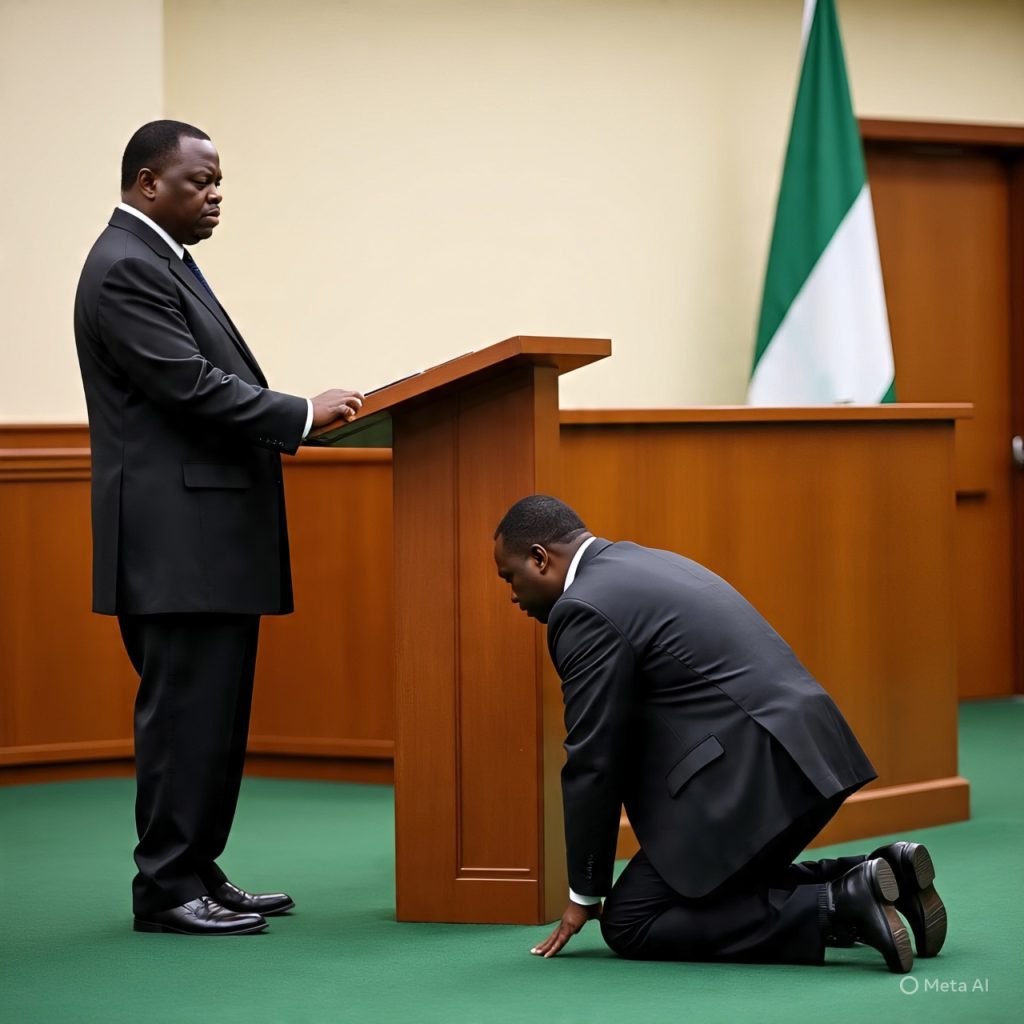
On Monday, 16th day of March 2026, the hallowed precincts of the Federal High Court, Abuja, witnessed a scene that has sent shockwaves through Nigeria’s legal firmament. Justice Mohammed Umar, presiding over the trial of activist Omoyele Sowore, allegedly directed defence counsel Marshall Abubakar to “step out of the Bar and kneel down” in open court. The lawyer’s offence? Raising his voice while addressing the court on the suitability of a hearing date. My first impression when I heard about it was that it was “fake news”.
What followed was a moment of high drama that encapsulates the tensions lurking beneath the surface of our judicial process. Abubakar, displaying commendable fortitude, refused the directive, insisting that kneeling before a judge was unknown to Nigerian law. As other lawyers rose to appeal for calm, the judge eventually adjourned proceedings, leaving the courtroom with the indelible image of a confrontation that should never have occurred.
The Nigerian Bar Association, through its President Mazi Afam Osigwe, SAN, responded with alacrity and clarity: “NO JUDGE HAS THE POWER TO ORDER A LAWYER TO KNEEL IN COURT.” This article, drawing upon the profound judicial philosophy of the Honourable Justice Chukwudifu Oputa as expressed in his seminal lecture “Contempt of Court and Discourtesy” delivered at the National Judicial Institute’s Continuing Education for the Judiciary Programme (30 October – 10 November 1989), the NBA’s authoritative statement, and comparative jurisprudence, examines the implications of this incident for justice delivery and the sacred partnership between the Bar and Bench in Nigeria.
THE LAW’S CLEAR MANDATE – PROCESS OVER PASSION
The NBA’s Principled Position
The NBA’s statement deserves close reading, for it articulates fundamental principles that should govern every courtroom in the land. The Association affirmed that while “judges are vested with the authority to maintain order and discipline in their courts, such authority must be exercised strictly within the bounds of the law and established judicial standards.”
This is not mere rhetoric. It is a restatement of the constitutional foundation upon which judicial power rests. The courtroom, as the NBA rightly observed, is “a temple of justice, governed by law, procedure, and decorum.” A temple requires order, but that order must itself be ordered by law. The power to punish for contempt, though well recognised, is “circumscribed by defined legal procedures designed to ensure fairness, objectivity, and respect for the rights and dignity of all persons appearing before the court.”
The Association’s conclusion is therefore inescapable: “A judex directing a legal practitioner or indeed any person whatsoever to kneel in court is not a recognised judicial sanction under our laws and does not align with the standards of judicial conduct expected on the Bench.” Where a judge believes contempt has occurred, “the judge MUST follow the accepted way of conducting proceedings for such allegations.”
The Wisdom of Justice Oputa on Judicial Temperament
It is here that the luminous jurisprudence of Justice Chukwudifu Oputa becomes indispensable. In his lecture “Contempt of Court and Discourtesy” (Judicial Lectures, MIJ Publishers Limited, 1989, Chapter 21, pp. 316–334), Justice Oputa devoted considerable attention to the proper judicial response to perceived provocation. His teachings read almost as a prophetic commentary on the incident of 16th day of March 2026.
On Patience and Maturity
At page 326 of his lecture, Justice Oputa identified patience as “an indispensable and invaluable judicial attribute,” requiring “a great deal of patience coupled with judicial dignity and tolerance to face irritating and exasperating situations in Court, without succumbing to emotional paralysis.” He warned in terms that resonate powerfully today: “An impatient Judge is no longer in control. Impatience can lead to precipitate action, where it could have paid ‘to take little notice’ and treat the contemnor and the contemptuous episode with merited scorn and disdain by ‘taking little notice of it'” (p. 327).
The incident in question precisely illustrates this danger. A lawyer raising his voice in vigorous advocacy – whether ill-advised or not – met with an immediate, extra-legal response. The judicial sword descended before the judicial mind had time to reflect. This is precisely what Justice Oputa cautioned against when he observed that “impatience can lead to precipitate action” (p. 327).
On Coolness Under Fire
Justice Oputa’s invocation of Lord Denning’s response to Miss Stone’s book-throwing is particularly instructive (p. 325). When a litigant threw books at the English Court of Appeal, the Court “took little notice,” understanding that the contemnor sought precisely the attention that a committal would bring. Lord Denning later reflected: “We do not fear criticism nor do we resent it.”
Justice Oputa drew from this the lesson that “a Judge should never be rude, as a result of, or over-sensitive to remarks made even against him in court” (p. 327). The Judge’s dignity, he insisted with characteristic profundity, “should rest on firmer foundations – on honesty, impartiality, wisdom, patience, integrity, alertness and sound knowledge of the law and rules of procedure and not on his ability to swing the sword of contempt” (p. 334).
The Iconic Quote
Perhaps the most iconic passage from Justice Oputa’s lecture, one that should be inscribed in every judicial chamber in Nigeria, appears at page 333:
“To arrive at the truth in the Court room, and thus at justice, one does not need the thunder and brimstone of a Mount Sinai. Rather one needs a relaxed atmosphere – the peace, the quietude and the serenity of the Mount of the Beatitudes. Both Bench and Bar should appreciate each other’s vital and necessary role in the adjudicative process, leading to mutual respect. And respect begets respect as confidence begets confidence.”
This profound observation captures the essence of what was lost in the Abuja courtroom on 16th day of March 2026.
The Fassassi Precedent: The Supreme Court’s Example
Justice Oputa pointed to the Supreme Court’s handling of Architects Registration Council of Nigeria v. Majoroh (No. 2) [1987] 3 NWLR (Part 61) 1 as the Nigerian exemplar of judicial maturity (pp. 326–327). In that case, counsel had openly accused the Court of bias and demanded an assurance of impartiality before proceeding – conduct that “obviously amounted to contempt of Court” (p. 326).
Yet the Supreme Court “took little notice” of the contempt, kept “cool under fire,” exhibited “requisite maturity,” and patiently retired to Chambers to write its ruling (p. 326). Justice Eso, JSC, observed in terms that should guide every judicial officer: “The honesty and integrity of a Judge cannot be questioned, but his decision may be impugned for error, either of law or of fact.”
The contrast with the incident of 16 March 2026 could not be starker. Where the Supreme Court responded to a direct accusation of bias with measured dignity, the Federal High Court responded to raised voices with an order to kneel. The former enhanced the judiciary’s moral authority; the latter diminishes it.
THE BAR-BENCH PARTNERSHIP – A DELICATE EQUILIBRIUM
Mutual Respect as Constitutional Necessity
The NBA rightly emphasised that “the legal profession thrives on a delicate but essential balance, one rooted in mutual respect between the Bar and the Bench. This relationship is fundamental to the administration of justice and must be jealously guarded.”
This is not mere sentiment. The administration of justice in an adversarial system depends upon a functional partnership between those who adjudicate and those who advocate. The Judge requires the assistance of counsel to navigate complex facts and law. Counsel requires the impartiality of the Judge to ensure their client’s cause receives a fair hearing. When either side forgets this mutual dependency, justice suffers.
The Boundaries of Advocacy
The NBA was careful to remind lawyers of their corresponding duties: “to conduct themselves with restraint, professionalism, and respect for the court at all times.” While “lawyers are entitled, indeed obligated, to advocate firmly and fearlessly on behalf of their clients, such advocacy must always be exercised within the bounds of courtesy and decorum.”
Disagreements with the court, “no matter how strongly felt, must be expressed through proper legal channels and not in a manner that disrupts proceedings or undermines the authority of the court.” This balanced formulation acknowledges both the advocate’s fearless duty and the imperative of orderly process.
Justice Oputa captured this equilibrium perfectly at page 333: “Strong, determined, vigorous and even pungent advocacy should be encouraged but in an atmosphere of unalloyed respect for the Judge and the dignity of the Court. Vigorous advocacy should not be confused with contempt. An advocate has no right to be rude to the Judge and the Judge has no right to be super-sensitive.”
The Spectre of the “Contempt Scare”
At pages 333–334, Justice Oputa warned of an equally dangerous phenomenon: the “contempt scare.” He observed that “as contempt of court tends to hinder, inhibit and obstruct the course of justice, even so, the scare of contempt, the dangling of the sword of contempt, like the proverbial sword of Damocles, over the head of learned counsel will also inhibit the attempt to arrive at justice. Both are thus counter-productive.”
A courtroom where counsel practise in fear of extra-legal sanctions is no less a threat to justice than a courtroom where counsel are disrespectful. The learned Justice’s insight is particularly poignant in the present context: the order to kneel, whether intended as punishment or humiliation, creates precisely the atmosphere of fear that inhibits the fearless advocacy upon which justice depends.
PROCEDURAL REQUIREMENTS AND THE LIBERTY OF THE SUBJECT
The Four Guiding Principles
At pages 321–326 of his lecture, Justice Oputa meticulously analysed the procedural requirements for contempt arising from disobedience of court orders. These principles, distilled from English and Nigerian case law, provide a framework for understanding why the directive to kneel was legally insupportable.
Principle No. 1: The Order Must Be Clear and Precise
Justice Oputa emphasised that “any application for committal for any disobedience of an order of court is a very serious matter as it seeks to deprive a Nigerian citizen of his fundamental right to his personal liberty” (p. 322). Consequently, “the order alleged to have been disobeyed must be clear and precise in terms and must inform the party against whom it is made what the court has commanded him to do or to refrain from doing.”
Principle No. 2: Procedure Must Be Strictly Followed
“Attachment and committal are very technical matters and as orders for committal or attachment affect the liberty of the subject such rules as exist in relation to them must be strictly obeyed” (p. 322). Justice Oputa cited Omopena v. Adelaja 19 NLR 71 and Gordon v. Gordon [1946] 1 All ER 247 in support of this proposition.
Principle No. 3: Strict Proof of Service
“In proceedings for Committal for any failure to obey an order of Court, it is imperative that the Order alleged disobeyed be strictly proved to have been served on the alleged contemnor before his alleged disobedience. Since committal affects the liberty of the subject the proof of service required should be proof of personal service and not of substituted service” (p. 323).
Principle No. 4: The Order Must Bind the Contemnor
Drawing from the Supreme Court’s decision in Majoroh v. Fassassi (No. 3) [1987] 3 NWLR (Part 59) 37, Justice Oputa held that if an alleged contemnor “became such officer after the making of the Order then he cannot be held to be in contempt of court for ‘disobeying an order which was not directed to him'” (p. 324).
None of these principles were satisfied by an oral directive to kneel.
The Proper Forms and Process
At page 324, Justice Oputa explained the statutory framework: section 72 of the Sheriff and Civil Process Ordinance confers jurisdiction to commit for refusal to comply with court orders. The procedure requires Forms 48 and 49 under Order 9 Rule 13 of the Judgment (Enforcement) Rules. “Form 48 serves as a warning and bringing to the notice of the party to be committed the consequences of his act if he continues to disobey the order of the court after service of the Court’s Order.”
The absence of any such procedural safeguards in the Abuja incident renders the judge’s directive not merely discourteous, but legally void.
IMPLICATIONS FOR JUSTICE DELIVERY
The Erosion of Public Confidence
When a judge orders a lawyer to kneel, the damage extends far beyond the immediate participants. Sowore’s reaction captures the public perception: “How do you expect justice in a country where a judge orders a solid lawyer to kneel down…?”
Public confidence in the judiciary – that intangible but indispensable asset – is eroded each time judicial authority is exercised arbitrarily. Citizens who witness lawyers being humiliated in open court may reasonably wonder whether their own cases will receive fair treatment. The perception of justice is as important as its reality, for as the maxim goes, justice must not only be done but must manifestly be seen to be done.
The Chilling Effect on Advocacy
Human rights lawyer Inibehe Effiong’s response is telling: “Corporal punishment has no place in the temple of justice. It is better to be imprisoned as a lawyer than to be compelled to kneel right in the courtroom.”
This defiance, however admirable, conceals a deeper concern. Young lawyers observing this incident may internalise the lesson that vigorous advocacy carries risks beyond the normal hazards of litigation. The “chilling effect” on counsel’s willingness to press difficult points or challenge judicial assumptions is real and damaging to the adversarial process.
Justice Oputa’s Warning on Discourtesy
At page 332, Justice Oputa drew a crucial distinction between what may annoy a judge and what amounts to contempt:
“When a judge does not agree with learned counsel’s method of advocacy, that in itself, is not contempt of his Court. Counsel has a constitutional right of audience. How he chooses to present his case is his own affair. It will be unconstitutional for a judge to abridge counsel’s right of audience by dangling the sword of contempt over his head.”
The learned Justice further observed that “judicial interruption can be irritating to counsel. And his reaction to such interruption is not necessarily contempt” (p. 332). He then recounted the celebrated exchange between Mr Justice Willis and the great R.E. Smith, where the judge asked “What do you suppose I am on the bench for?” and Smith replied with a bow: “It is not for me to fathom the inscrutable ways of Providence” (p. 332).
This exchange, marked by wit rather than wrath, exemplifies the civilised discourse that should characterise our courts.
THE WAY FORWARD
Institutional Response and Accountability
The NBA has indicated it will “engage with relevant authorities to ensure that the rule of law, professional standards, and judicial ethics are upheld.” This engagement must be robust and principled. Where judicial conduct falls below expected standards, appropriate mechanisms – whether the National Judicial Council or other bodies – must be invoked.
But institutional response must be matched by institutional self-reflection. The National Judicial Institute’s continuing education programmes should incorporate Justice Oputa’s teachings on judicial temperament. Newly appointed judges must understand that their authority flows from law, not from personal dominance. As Justice Oputa reminded us at page 334, “the dignity of the trial Judge should rest on firmer foundations – on honesty, impartiality, wisdom, patience, tolerance, alertness and sound knowledge of the law and rules of procedure and not on his ability to swing the sword of contempt.”
A Compact for the Future
The incident of the 16th day of March 2026 should serve as a catalyst for renewed commitment to the Bar-Bench compact. Both sides should reaffirm:
For the Bench: That judicial authority will be exercised within legal bounds; that contempt will be addressed through established procedures; that judicial dignity rests on impartiality and learning, not on humiliation of counsel; and that patience and coolness under fire are judicial virtues of the highest order.
For the Bar: That advocacy will be fearless but respectful; that disagreements will be expressed through proper channels; that counsel will assist, not obstruct, the judicial process; and that the dignity of the court will be upheld even in vigorous contestation.
The Iconic Lesson
Let us return to Justice Oputa’s iconic words at page 333:
“To arrive at the truth in the Court room, and thus at justice, one does not need the thunder and brimstone of a Mount Sinai. Rather one needs a relaxed atmosphere – the peace, the quietude and the serenity of the Mount of the Beatitudes.”
This is the lesson that the incident of 16 March 2026 should teach us all. Not that judges lack authority – they possess it in abundance. But that authority, like all power in a constitutional democracy, must be exercised within the limits prescribed by law and guided by the wisdom of those who have gone before.
CONCLUSION: AND THE TEMPLE MUST STAND
The courtroom is indeed a temple of justice. Its foundations are law, its pillars are procedure, and its atmosphere must be conducive to the solemn work of adjudication. But temples are desecrated not only by those who disturb their peace, but also by those who abuse their authority.
Justice Oputa’s closing words in his lecture (p. 334) resonate across the decades: “Both Bench and Bar should appreciate each other’s vital and necessary role in the adjudicative process, leading to mutual respect. And respect begets respect as confidence begets confidence.”
The incident of 16 March 2026 represents a failure of this mutual respect. But from failure can come renewal. If the legal profession – both Bench and Bar – uses this moment to reflect, to learn, and to recommit to the principles that Justice Oputa so eloquently articulated, then the temple of justice may emerge stronger than before.
The alternative is unthinkable: a judiciary where authority rests on intimidation rather than law, and a Bar where advocacy is tempered by fear rather than guided by ethics. That path leads not to justice, but to its opposite.
Nigeria deserves better. The legal profession must ensure it receives nothing less. May the day never come when a Judge is conferred with the power to order Counsel to kneel as punishment in open Court before litigants!
E. Monjok Agom
18th March, 2026
Independent journalism, sustained by readers like you.
The Parliament Diary is published by The Parliament Cable Network Service Limited. Your support helps us keep covering governance, parliamentary affairs and grassroots politics across Nigeria.